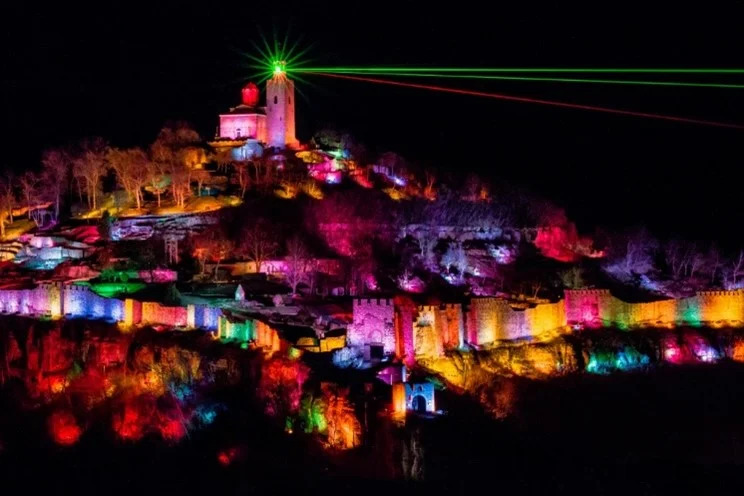


For more than two centuries Tarnovgrad has been the capital of the Second Bulgarian Kingdom. It was the centre where the most important political, religious, administrative and cultural issues in the life of the medieval state were decided.
The dominating position of Tsarevets Hill and its natural inaccessibility predetermined the choice of this hill to be the centre of the supreme government of the state. An elaborate fortification system ensured the safety of those living in the fortress. The main entrance to the interior is from the west. It is defended by four successive gates and towers above them. In front of the first gate there was a movable wooden bridge. Near the innermost gate are the guard barracks.
The rest of the fortress is densely built up. Archaeological excavations have uncovered the foundations of 470 residential buildings, an architectural complex inhabited by a high-ranking Bulgarian aristocrat, a country house. During the metropolitan period, 23 temples and 4 city monasteries functioned in the fortress. Their facades were executed in the typical picturesque style of the period, and their interiors were covered with magnificent frescoes.
The show „Sound and Light“ is broadcast in Veliko Tarnovo all year round. The idea is to recreate the history of Tsarevets Hill through music and light effects.
History:
At the time when Tarnovo was the capital of Bulgaria, the brothers Asen and Petar ruled. Bulgaria was under Byzantine rule. On October 26, 1185. an uprising broke out against the Byzantine emperor Isac II Angel. The specific reason was the taxation of the Bulgarians through a new extraordinary tax, with which Isaac would fill his treasury for his forthcoming marriage to a young Hungarian princess. This caused strong discontent on the part of the Bulgarian people, which was headed by the brothers Theodore and Assen. They both want Isaac Angel to give them Trapezitsa Hill as a pronia (lifelong possession). After the emperor refused, the brothers announced the beginning of the uprising against the Byzantine Empire. The eldest of the brothers, Theodore, was proclaimed king of the Bulgarians and Vlachs, and in order to maintain his continuity with the First Bulgarian Kingdom, he adopted the name Peter. In fact, in order to attract the Bulgarians to their side, the two brothers used a small lie. They announce that the miraculous icon of St. Dimitar disappeared from Thessaloniki and unexpectedly appeared in the church in Tarnovo named after him. By which they make it clear that the saint has turned his back on Byzantium and in the future military conflict will support the Bulgarians and the cause of their liberation. The uprising lasted until the spring of 1187, when Emperor Isaac Angel, after being defeated several times by the brothers’ troops, was forced to conclude a truce, recognizing the restoration of the Bulgarian state in the lands north of the Balkan Mountains. At the head of the Second Bulgarian Kingdom for the next 100 years he ruled the Asenevtsi dynasty, which expanded its territories and waged successful wars with its neighbors and turned the Bulgarian state into a primary power not only in the Balkans but throughout Europe.